
Department of Business Administration,
SUNY Fredonia
robinson@fredonia.edu
November 9, 2024
The 2024 Election
For those of us who are environmentalists, Donald Trump’s reelection makes us very nervous. We recall his management of the EPA during his last term, and his stated desire to bring back blast furnaces producing steel in Pittsburgh. We also recall his repeated dangerous denial of climate change. We also remember his many attacks on our national public lands, and his foolish “drill baby drill” ignorance. (We already produce more oil than any other country, and our technology allows us to pump much more from our old wells. New wells are really not needed.) Donald Trump is far from being environmentally friendly.
So we are all nervous; that is not surprising! But I suggest we should remain active in our environmental activities. The issues involving our rivers, estuaries, our Great Lakes, and other water bodies are too important to turn our attention away. We have species to protect, climate to fix, and we must promote the recognition that the environment is part of our common wealth, i.e. it belongs to us all.
Second Edition of Text
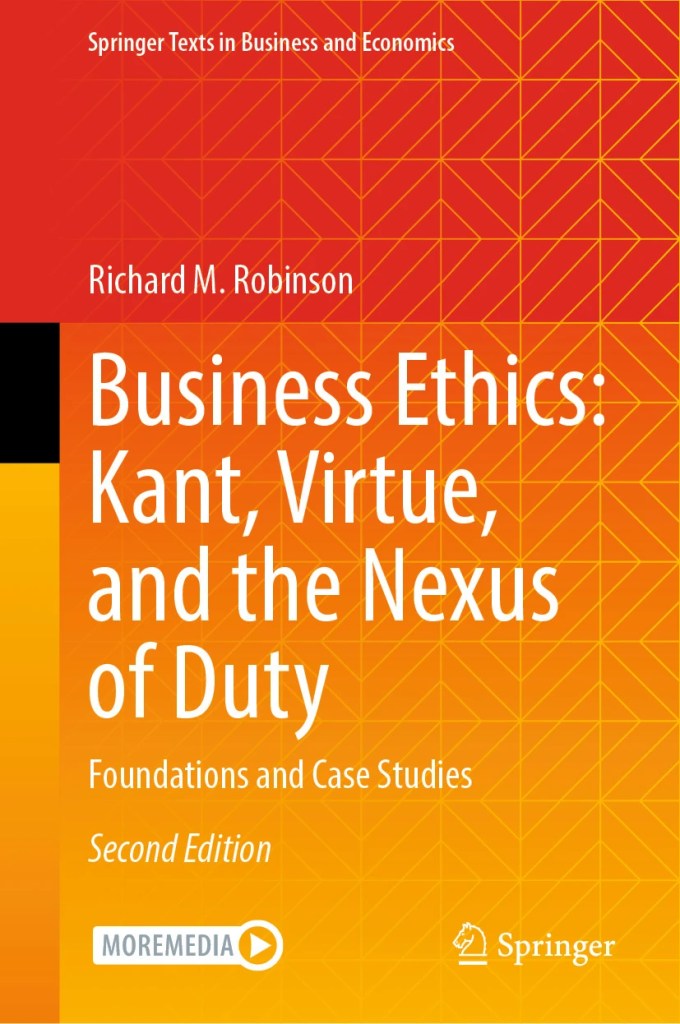
My second edition of Business Ethics: Kant, Virtue, and the Nexus of Duty, came out last July 15. (Springer Texts in Business and Economics) It has two new chapters that both concern issues in environmental ethics. It also has several rewrites of other chapters, especially those that concern “boycotts and the pricing of ethics.” I hope students and instructors are satisfied with this new effort. The first edition was published in 2022, and had over 13k accesses. The second edition already has more than 1,700 accesses in only four months. Thanks to all who have used it. Please contact me about your criticisms and ideas.
A New Book Titled Restoring America’s Rivers
My new book with Springer’s Palgrave Macmillan scholarly book series is titled Restoring America’s Rivers. It is now in production and might take a month or two before printing. The subject concerns our national dam removals and our overall river restoration movement. That movement began in Maine in 1999, and has now led to the recent (Summer and Fall of 2024) large dam removals on the Klamath River. We have now had many large and successful dam removals and river restorations (such as on the Olympic Peninsula’s Elwha River). We have also removed large numbers of “low head dams.” These are derelict structures that destroy our rivers’ ecologies and are also very dangerous to those who interact with them (paddlers, swimmers, fishermen and women). I try to keep up with this rapid and significant river restoration movement. I hope this new effort will help people recognize the scale and importance of this important restoration movement. That is why I believed the book needed to be written.
There is now a sizeable literature on the science of river restoration especially after dam removals. But my book concerns the movement for restorations and its underlying economics.
Please keep checking with Springer about when it will be available.
Past Book Publications
As for my past books with Palgrave Macmillan, Imperfect Duties of Management: The Ethical Norm of Managerial Decisions (2019) now records 3,430 accesses; Environmental Organizations and Reasoned Discourse (2021) has 2,283 accesses; and Environmental Advocacy and Local Restorations (2023) has 1,200 accesses so far. Please let me know what you think about any of these efforts. (email at robinson@fredonia.edu) I very much appreciate those who purchase the above.
New Possibilities
I’ve been working hard on exploring the subject of the restoration of America’s steel cities. This would include the Renaissance in Pittsburgh of course, but also the attempts to rebuild many of those areas that big steel (meaning big blast furnaces that once polluted severely) have abandoned. We now use mini-mills with electric arc furnaces that mostly use recycled steel. Some cities have handled restoration well, but others are struggling. The exploration is interesting.
I am also exploring the fascinating subject of the evolution of imperfect duties into perfect duties. This is an important issue in bureaucratic behavior in business and in government. (Please see my 2019 publication listed above. Also see my 2017 Journal of Business Ethics article.) If anyone has any examples or insights concerning this phenomenon, please let me know. Perhaps we can work together to develop the subject.
I appreciate your interest.
Rich Robinson
 Prof. Richard M. Robinson, PhD