___________________________________________________________________________________________
July, 2025
___________________________________________________________________________________________

Department of Business Administration,
SUNY Fredonia
robinson@fredonia.edu
July 9, 2025
The Trumpian Environment
We are now swamped with President Donald Trump’s anti-environment policies. He refuses to recognize that climate change exists; that it is caused by humanity’s infesting our atmosphere with carbon-based gases; and that this is causing a significant disaster for global civilization. Consequently, he has eliminated federal funding for new alternative energy programs right at the time when we have been making great advances. Instead, he has announced he wants the US to burn more fossil fuels. The rest of the world will move forward with advancing wind and solar energy, and with massive advances in battery storage, but for at least a few years our US Federal Budget will not continue with these investments in technology.
As an academic who instructs university courses in business, I find it impossible to pretend that we are not facing one of history’s greatest crises. Restoring and protecting our environment is the campaign of our times. Climate change means that our economies are trying to adjust to new locations and methods for agricultural production; that populations are migrating at levels previously not witnessed; and that our energy production methods must radically change. The food we eat, the way we house ourselves, the way we transport ourselves, and all other aspects of our lives will be substantially affected.
I will not likely see the coming mid-century, but my students of this Fall Semester will. They need to aim their careers for that day twenty-five years from now because it will likely be very different from today. When Joseph Schumpeter, the great economist of the first half of the last century, posed his notions of “creative destruction,” I don’t think he envisioned such a great destructive force affecting all of civilization. But now humanity’s “creativity” must respond. This coming wave of creative response is what the new generation will be about. How do we prepare students in current business schools to boldly confront these changes and shape their educations and careers accordingly? That is the problem I and my colleagues face as instructors.
A New Book Now Published
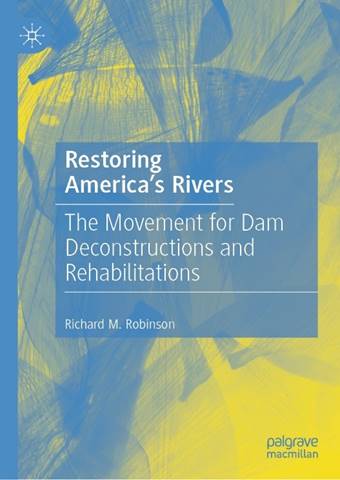
My new scholarly book became available in e-book on July 3, and will start being shipped in hardback-print form on (or before) this August 3. Restoring America’s Rivers: The Movement for Dam Deconstructions and Rehabilitations is published by Palgrave Macmillan, the scholarly book imprint of Springer Nature. (Hardback print is ISBN: 978-3-031-81757-1) This book examines the phenomena of the recent movement for dam removals for the ecological restoration of our rivers, and also for safety reasons, and also to pursue environmental justice for Native American Tribes. America’s dams are generally old and mostly low-head structures on smaller tributaries. A large portion have lost their original purpose and are often abandoned and derelict. They destroy the ecology of our rivers and are dangerous to recreators because of the turbulence they create. Fishermen, swimmers, and paddlers get trapped and some drown. These dams should be removed. Many of even our larger concrete dams are dangerous and in need of either refurbishment or removal. The movement for removal of these larger structures – which are often derelict without any remaining purpose – is also very popular for recreational purposes, particularly among our paddle craft enthusiasts. This scholarly book documents and examines our dam removal movement.
Writing this book was a very lengthy effort. My hope is that we recognize this important movement, that we very much appreciate those involved in our dam removals, and also our local officials in charge of inspecting our dams and demanding that our dam-safety issues be addressed. The Association of State Dam Safety Officials (ASDSO) is the organization of local inspectors who have established our dam safety classifications. With a small number of inspectors in each state, they attempt to examine thousands of dams per state, and when they do discover unsafe dangerous situations, they often find it difficult to enforce remediations. We should pay attention to the efforts of this worthy organization.
With respect to dam removals, we should greatly appreciate the efforts of American Rivers, a leading environmental advocacy organization pursuing our river restorations.
Second Edition of the Business Ethics Text
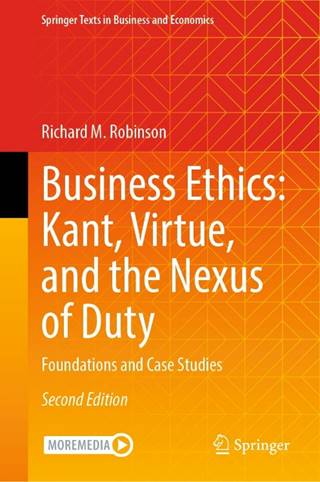
The second edition of Business Ethics: Kant, Virtue, and the Nexus of Duty (Springer Texts in Business and Economics) has now been out for about a year. It has approximately 5,000 accesses over these past twelve months, which is considerably more than I had expected. So I appreciate and thank all those who have shown interest. If you have used and are familiar with the first edition, there are a couple of new environmental chapters in this second edition, and some other rewritten chapters. I sure need your opinions and ideas for new review questions, or other possible material for inclusion. You can always reach me at richard.robinson@fredonia.edu. I am interested in the material you might be including in your course, and your own instructional ideas. I have been offering “Business and Ethics” just about every semester for more than twenty years, but this Fall Semester I will once again be seeking to improve my material and presentation.
A New Text and New Scholarly Book?
My Springer Nature editor and I have been working on a new text, Business and the Environment. This new volume will be aimed at a senior undergraduate level, or MBA level. It emphasizes an ethical approach to dealing with our environmental crises. This will use a “duty of virtue” approach (Kantian “imperfect duty”) to address the future directions of business in this essential subject. Original drafts are now being reviewed by knowledgeable academics, scholars, and editors. I would love to have this text available for the beginning of 2026, but that might be overly ambitious.
I am also trying to develop a new scholarly book on regional economic restorations that concerns our “Steel Cities.” We have witnessed tremendous change in many cities like Pittsburgh that once were based on the old blast-furnace technology of steel production with its enormous air and water pollution. We now use the much cleaner electric-arc technology, and we use it to recycle old scrap steel. This production is located in our Mid-South States, and it leaves our rust-belt northern cities to adjust. This is a tremendous change. But our old blast-furnace derelict hulks remain in many of these rust-belt cities. Some of these old cities have adjusted well, and have reconstructed their economies to be strong and clean. Some others are now making progress, and some cities are not doing as well. I believe this book could be an important contribution to our regional economics analyses. There is, however, a lot of work left for me to do on this material.
End of My Sabbatical
I’ve been on sabbatical for this past academic year (my third semester on sabbatical within an academic career that spans 45 years). For this sabbatical, my primary working area has been my upstairs home office. But I now have to clean up this office of its stacks and stacks of papers and books (massive amounts of downloaded data and articles, drafts of the chapters that made it to print, and of material that has not yet made it to print, plus books that I’ve used for reference, and many scholarly books and texts some of which have been old treasures, but some just perplexing in their exegeses). I am not a neat worker. I must now organize this office to enable a focus on my new tasks. I have to return to class preparation and to transporting myself to Campus, and to doing the “wonderful” committee work of academic life. This will all be an adjustment that I hope will come easily. If you do encounter me in some way, please remember that I’m a bit old and slow.
Rich Robinson
SUNY Fredonia
 Prof. Richard M. Robinson, PhD